Learn. Build. Succeed.
Your Welding Journey Starts Here.
Welcome to the American Welding Academy Blog — your source for welding insights, training tips,
student success stories, and industry news. Stay informed, stay inspired, and keep building your future one weld at a time.
Pipe Welding 101: The Basics Every Beginner Needs to Know
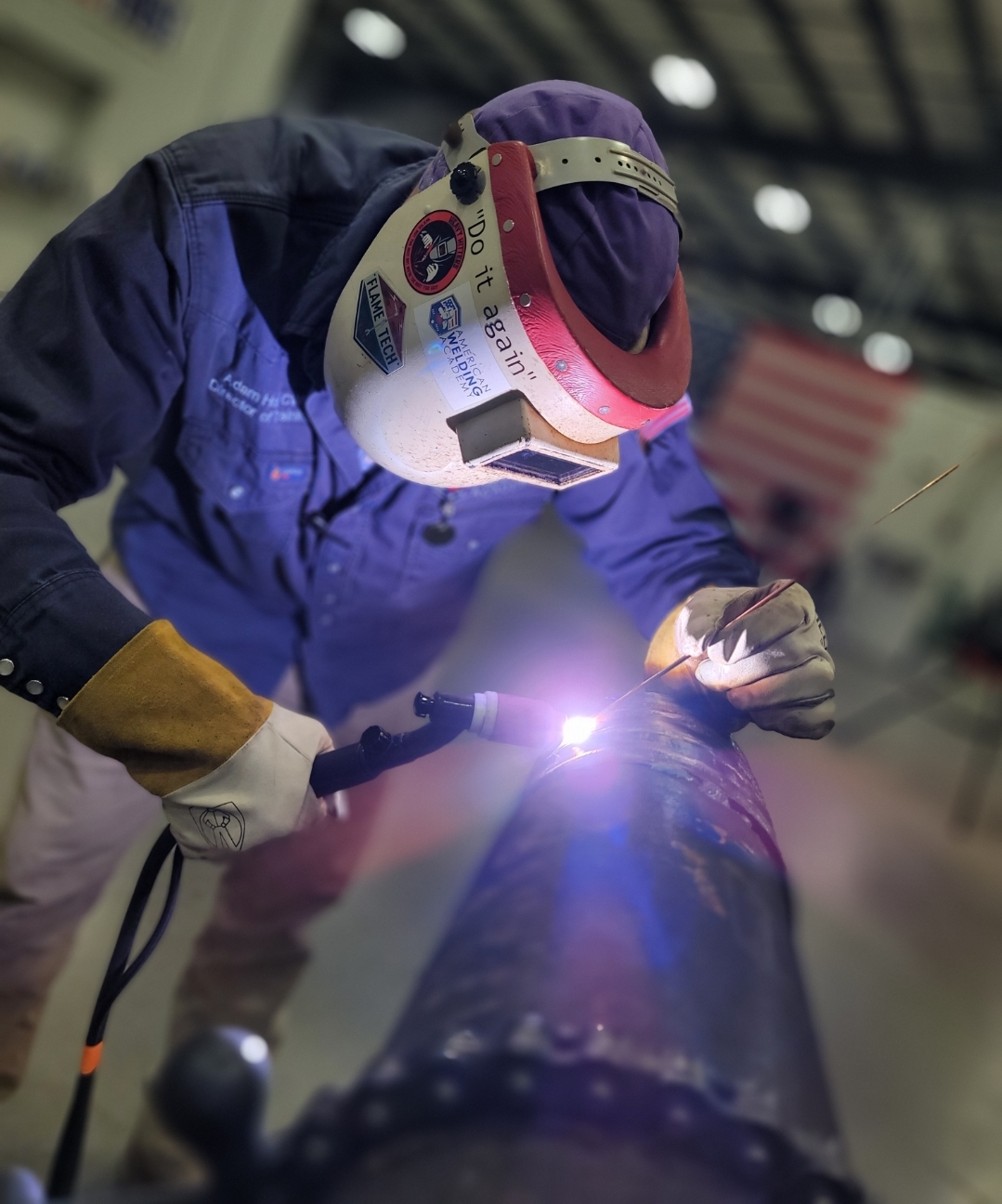
Pipe welding is one of the most respected and technically demanding areas within the welding trade. For beginners, it can feel intimidating at first, but understanding the fundamentals makes the learning curve far more manageable. Pipe welding plays a critical role in industries such as energy, manufacturing, construction, and healthcare infrastructure. Systems that transport liquids, gases, or steam rely on properly welded pipe to operate safely and efficiently. Learning the basics early helps new welders build confidence and develop habits that support long-term success.

Pipe Welding Fundamentals Every Beginner Should Understand
At its core, pipe welding involves joining cylindrical components so they can safely carry substances under pressure or heat. Unlike flat plate welding, pipe welding often requires working around a fixed joint, adjusting body position and technique as the weld progresses. This means beginners must learn to control the weld puddle in multiple positions within a single joint.
Joint preparation is one of the most important fundamentals. Proper beveling, cleaning, and alignment ensure good penetration and fusion. Fit-up errors can cause defects even if the welding technique itself is solid. Beginners quickly learn that patience and preparation are just as important as striking an arc. Fundamentals also include understanding welding positions such as horizontal, vertical, and overhead, since pipe joints often require all three.
Common Pipe Sizes, Materials, and Applications
Beginners are typically introduced to standard pipe sizes measured by nominal pipe size rather than actual diameter. Understanding wall thickness, commonly referred to as schedule, helps welders anticipate heat input and penetration requirements. Thin-wall pipe behaves very differently from thicker materials, especially during root passes.
Common materials include carbon steel, stainless steel, and alloy steels. Each material responds differently to heat and requires specific techniques and filler materials. Carbon steel is often used for training because it provides a strong foundation for learning heat control and puddle behavior. Exposure to different materials helps beginners understand how welding skills translate across industries and applications.
Basic Techniques, Safety, and Good Habits
Pipe welding techniques build on basic welding skills but add complexity due to position and joint geometry. Unlike flat or simple fillet work, pipe forces welders to manage constant changes in angle, gravity effects, and visibility as they move around the joint. Beginners start by learning how to control travel speed, electrode angle, and heat input to maintain consistent penetration. They also learn that small adjustments matter more on pipe because the joint “responds” differently at the top, sides, and bottom of the run.
Root pass control is emphasized early because it forms the foundation of the entire weld. A clean, uniform root sets up the hot pass and fill passes for success by reducing the chance of trapped slag, lack of fusion, or internal discontinuities. Welders practice consistent keyhole control, steady tie-ins, and smooth restarts so the inside profile stays even. When the root is unstable, every pass after it becomes a correction instead of a build.
Fit-up and joint preparation play a bigger role in pipe welding than many beginners expect. Controlling land, gap, alignment, and bevel condition helps the welder maintain a predictable puddle and avoid chasing the joint as conditions change. Consistent tacks, proper spacing, and checking high-low (internal mismatch) prevent problems that technique alone cannot overcome. Good pipe welders treat preparation as part of welding, not something that happens before welding.
Tools Used for Pipe Welding
Pipe welding requires a specific set of tools designed to handle the unique challenges of working with cylindrical joints in various positions. The primary equipment includes welding machines capable of SMAW (Stick), GTAW (TIG), or GMAW (MIG) processes, depending on the material, code requirements, and project specifications.
TIG welding is often used for root passes on high-quality pipe work, requiring a TIG torch, tungsten electrodes, filler rod, and precise gas flow control. Stick welding remains popular for fill and cap passes, especially in field conditions, using electrode holders, ground clamps, and a reliable power source. Pipe welders also rely on angle grinders for beveling, cleaning, and removing slag between passes. Wire brushes, chipping hammers, and flap discs help maintain joint cleanliness, which is critical for preventing defects like porosity and lack of fusion.
Beyond welding equipment, pipe welders use specialized tools for fit-up, alignment, and inspection:
Pipe clamps, such as chain clamps or external lineup clamps, hold sections in place during tack welding and ensure proper gap and alignment.
Inside diameter (ID) clamps are used when external access is limited.
Welders measure bevel angles and root openings with gauges and calipers to confirm they meet specifications before striking an arc.
A magnetic level or protractor helps verify pipe positioning, especially when working on slopes or in the 6G position.
Welders also carry personal protective equipment, including welding helmets with proper shade lenses, flame-resistant clothing, gloves, and respiratory protection when working in confined spaces or with coated materials. Having the right tools and knowing how to use them efficiently separates hobbyists from professionals capable of meeting industry standards and passing rigorous inspections.
Where Pipe Welding Skills Make a Real-World Impact
Reading about welding and actually striking an arc are two very different experiences. True welding proficiency comes from hands-on practice under the guidance of experienced instructors who can help you refine your technique and build confidence.
At the American Welding Academy, we believe in learning by doing, which is why our programs emphasize practical training that prepares you for the realities of the job site. We offer comprehensive programs in welding and fabrication that provide a solid foundation from which you can build your career. Explore our programs, connect with us online, or call (636) 800-9353 to learn more about enrollment, program details, and how AWA can help you launch a long-lasting career.

Building careers in welding for over 20 years. Your future starts here.
Programs
Pipe Welding & Fitting
Fabrication Welding
Custom Classes
Programs
Contact Us
Copyright © 2025 All rights reserved The Welding Academy


